
The Dead Fathers
A novel by John Bennion
Once at a conference with Lance Larsen, someone asked what he mostly wrote about. I butted in and said, “What it means to have a body.” When I asked Lance about my main thematic concern, he said, “That’s easy—community,” My judgment of his poetry may have been too limited, but he was spot on about my writing.
My polygamist murder mysteries, An Unarmed Woman and Ezekiel’s Third Wife, explore what happens when someone murders someone else in a small Mormon town. Spin explores how we make choices and what happens when a woman is cut off from her community and support system. Both Falling Toward Heaven and Ruth at the End of the Earth explore how two people from different community systems struggle to form a marriage.
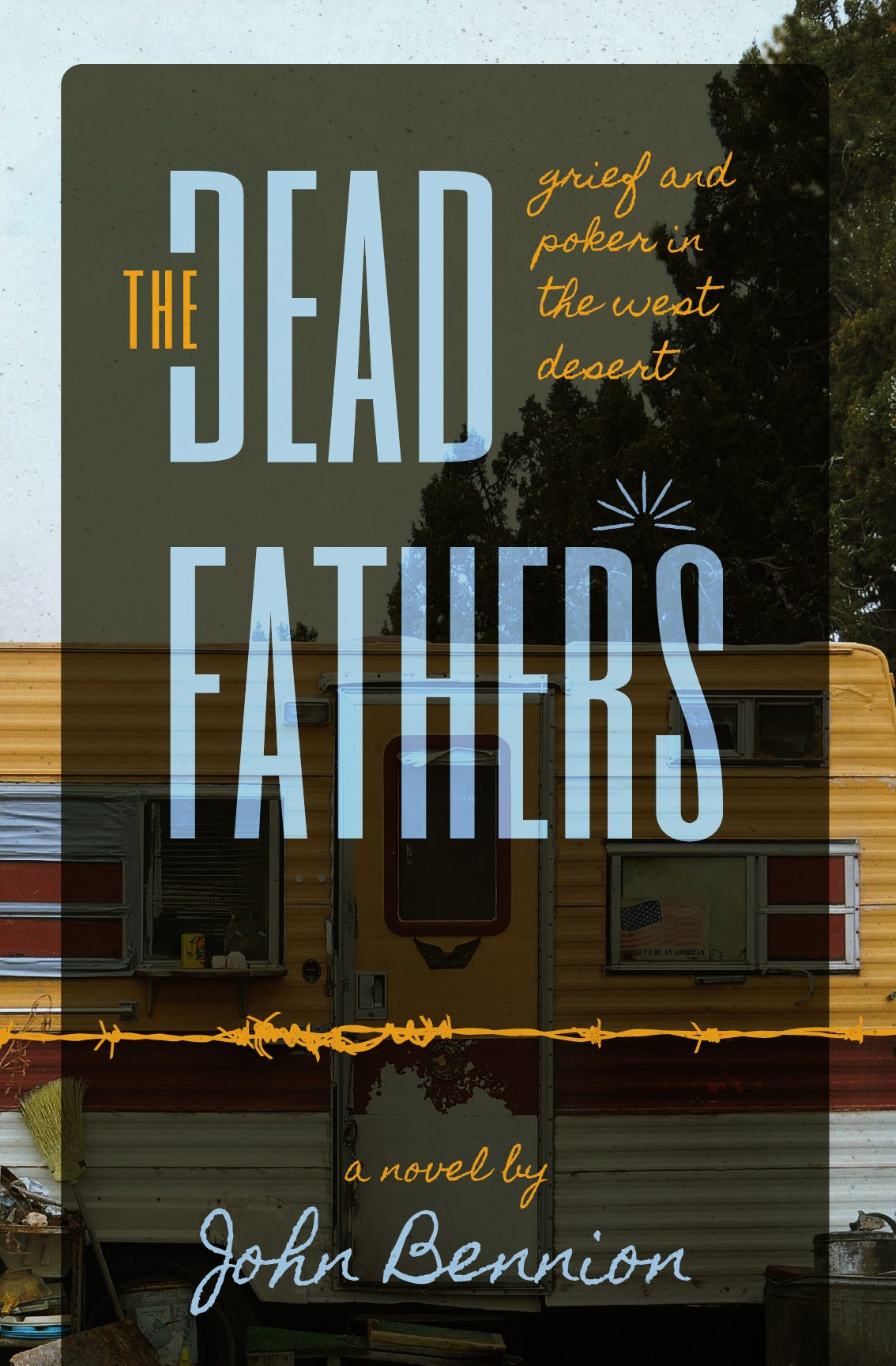
The same is true of my new novel, The Dead Fathers. After his wife of 40 years has an affair, Christopher Twist leaves home, family, community, to be alone in the West Desert of Utah, where he plans to shuffle toward death. His goal has a couple of impediments: the solitary desert of his youth where he worked summers on his grandfather’s farm is now full of roaring ATVs, corporate mineral hunters, clusters of motorhomes and trailers with MAGA flags flying above, and polygamists who try to convert him. Worst of all, every night his father, grandfather, and second great grandfather visit him and want to play poker. For them the game is not about winning or losing, although they always win, but has a mystical purpose, somehow connected to an impending catastrophe on both sides of the veil. They hint that Chris will play a role in what is thundering toward him. Feeling afflicted by his Dead Fathers and the other invaders in what he’s thought of as his desert, Chris soon finds allies he didn’t know he needed.
Writing this novel was a joy, an escape from my usual dour vision of the universe. I hope readers also feel the celebration.
—John Bennion
John Bennion is at it again. Spin meets Ruth at the End of the World and Ezekiel’s Third Wife in his new novel, The Dead Fathers: Grief and Poker in the West Desert, where questions of chance, of environmental catastrophe, of gender and authority and fundamentalist delusions, all collide. Protagonist Christopher Twist deals with his dead ancestors and his living family, philosophizing, wandering, conversing in words sacred and profane. What are prime causes, what are effects? What are the roles of minor individuals in major conflicts? As in all Bennion’s novels, there’s much to mine here—literally, this time. This is deep stuff, mines and mazes real and metaphorical. Once again, John Bennion invites us into and beyond his characters’ twistiest explorations.
—Julie J. Nichols, author of Pigs When They Straddle the Air
The Dead Fathers: Grief and Poker in the West Desert is a busy novel set in a deceptively quiet landscape: a multitude inhabits Utah’s stark and gorgeous West Desert, manifestations of an old man’s fractured mind and heart. The abundant cast conjures myth and magic, philosophy and theology, politics, physics, history, sense and nonsense. Ancestors and descendants compete for validation. Conscience disturbs habits of compliance. Senescence clings to tender nostalgia and primal hurt. All of this makes for an engrossing read, but the plot’s through-line is the real reward: accumulating gestures of desire, of mature marital reinvention despite—or maybe because of—a long season of disillusion. Read this novel with slow pleasure, immersed in dry water—a sweeping yet intimate landscape John Bennion understands like no other author I have read.
—Karin Anderson, author of Before Us Like a Land of Dreams, What Falls Away, and Things I Didn’t Do
This is a novel obsessed with opposites, starting with its very form. It’s a novel about a man who would be alone in deserted space. Yet this novel provides him with all sorts of company, from strangers to his wife, from the living to the dead, from the Three Nephites (one of whom is a woman, did you know?) to cryptobiotic soil. He is visited almost nightly by his dead father, grandfather, and great-great-grandfather. He is visited by polygamists and an Army general. He is discovered by a brilliant Dutch philosopher/scientist. Yet The Dead Fathers, for all the noise and chaos, never stops being quiet and still.
—Theric Jepson, author of Just Julie’s Fine and Byuck, co-editor of Monsters and Mormons, and editor of Irreantum